Gallery Wall Mistakes: 10 Common Problems and How to Fix Them
Ten common gallery wall mistakes, from frames hung too high to uneven gaps and a missing anchor piece, each with the reason it happens and a practical fix that rarely means starting again.
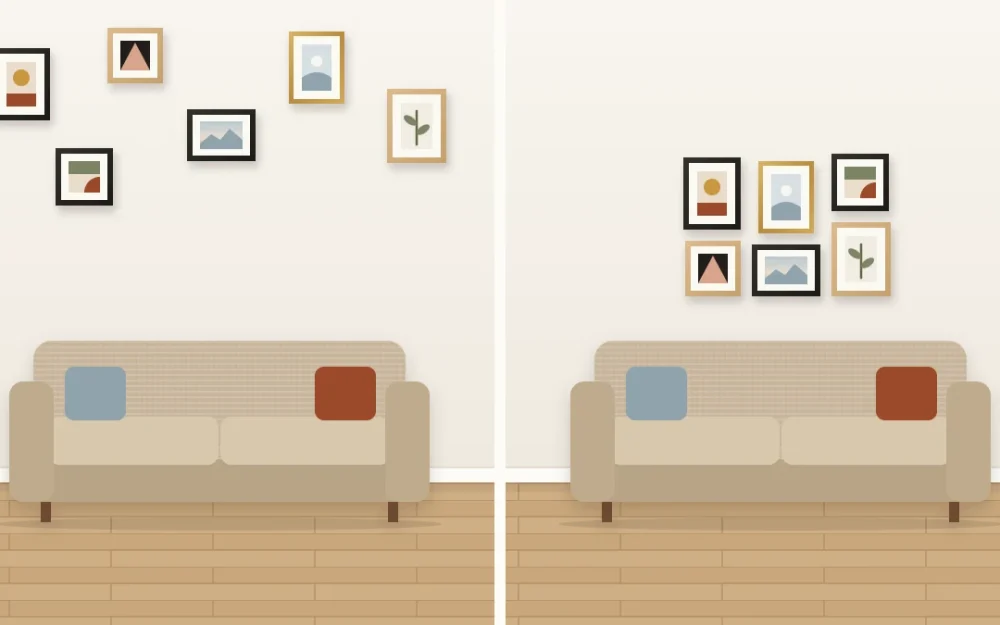
A wall can have good pictures in good frames and still look slightly wrong. The cause is almost never your taste. It is usually one of a handful of gallery wall mistakes that are easy to make and, fortunately, easy to name.
The ten below are grouped by what they affect: where the group sits, how big it reads, how consistent it looks and how it was hung. Each comes with a short diagnosis and a fix, and most fixes mean moving a few frames, not starting again.
Find your problem by its symptom
- The display looks cut off from the room: see mistakes 1 and 2.
- It looks crammed: see mistake 3.
- It looks thin, lost or aimless: see mistakes 4 and 5.
- It looks messy or busy: see mistakes 6 and 7.
- It has extra holes or frames that keep shifting: see mistakes 8, 9 and 10.
Position: where the group sits
1. Hung too high above the furniture
Why it happens: frames go up at standing eye level out of habit, or high enough to stay well clear of heads. A wide band of bare wall then separates the art from the sofa or console, and the two stop reading as one scene.
Fix: lower the whole group until the lowest frames sit a hand’s width or two above the furniture, then judge it from across the room. Whatever hangs above the sofa needs to be securely fixed.
2. An arrangement that ignores the furniture below
Why it happens: the group was centered on the wall while the furniture sits off to one side, or it runs much wider than the piece beneath it.
Fix: treat the furniture as the base of the composition. Center the group on it and keep the display a little narrower than it. If the furniture cannot move, shift the outer frames to the other side.
3. Filling the wall edge to edge
Why it happens: empty wall feels like wasted space, so frames creep toward the corners, the ceiling and the door frame.
Fix: bare wall around the group is what makes it read as a group. Take down the outermost pieces and leave a clear margin on every side, noticeably wider than the gaps between frames.
Scale: how big the group reads
4. Pieces too small for the wall
Why it happens: small frames are cheaper and easier to collect, and they look bigger in the hand than on a wall.
Fix: pull the frames closer so they act as one larger shape. If that is not enough, add one or two clearly larger pieces, reframe a favorite with a wide mat, or move the set to a narrower wall where it fits.
5. No anchor piece
Why it happens: every piece is about the same size and strength, so the eye has nowhere to land and keeps wandering.
Fix: choose one piece to lead, usually the largest or boldest, and place it at or near the middle with the others stepping down in size around it. A grid of identical frames is the exception; there the whole block is the anchor.
Consistency: how calm it looks
6. Gaps that vary without intent
Why it happens: frames were hung one at a time by eye, and each gap was judged against its neighbor only.
Fix: pick one gap and repeat it across the group, using a strip of card cut to that width as a spacer. The guide to gallery wall spacing explains how to choose the gap for your frames and wall.
7. Too many competing colors or finishes
Why it happens: the collection grew piece by piece, and each frame was chosen for its own picture.
Fix: limit the frames to two or three finishes and make sure each appears more than once, spread across the arrangement. Do the same with the strongest colors in the art. If one side still feels heavier than the other, the guide to gallery wall balance shows how to redistribute the visual weight.
Method: how it was hung
8. Skipping the layout test
Why it happens: impatience. The first frame goes up, and every later decision is forced by the ones before it.
Fix: arrange the pieces on the floor first, then preview them on the wall with paper templates of each frame. If you tape paper to the wall, remember that paint finishes and surfaces vary: test the tape in a hidden spot and follow the manufacturer instructions for use and removal.
9. Hardware that does not suit the wall or the weight
Why it happens: whatever was in the drawer got used for every frame, from the smallest print to the big mirror.
Fix: choose mounting hardware for your wall type and for the weight of each piece, and follow the hardware manufacturer instructions. For a mirror or a large glazed frame, get help if you are unsure.
10. Frames that drift crooked
Why it happens: a frame on a single central point can pivot, and closing doors, dusting and passing shoulders nudge it a little each time.
Fix: where the frame allows, hang it from two points instead of one. Small soft bumpers on the lower back corners help the frame grip and sit parallel to the wall. Check the first frame with a level, since the rest will be judged against it.
Repairing a wall that is already up
Take a phone snapshot of the wall and look at it small. Problems that are hard to see in the room are often obvious at thumbnail size: a group floating too high, a hole in the middle, one crowded corner.
Change one thing at a time, starting with whatever affects the whole group. Height and position come first, then gaps, then individual swaps. Many walls need only the first correction.
You rarely need to take everything down. The guide on how to update a gallery wall without starting over covers re-spacing, adding pieces at the edges and dealing with the holes that moving frames leaves behind.
Frequently asked questions
Why does my gallery wall look cluttered?
Usually because too many things differ at once: several frame finishes, uneven gaps and strong colors with nothing repeated. Reduce the finishes to two or three, make the gaps consistent and leave a clear margin of bare wall around the group. Removing two or three pieces often helps more than rearranging all of them.
Can I fix a gallery wall without rehanging everything?
Often, yes. Start with the change that affects the whole group, such as closing up the gaps or adding one larger piece near the middle. A phone snapshot viewed small helps you see which single change matters most. Moving frames leaves old holes, so plan where each piece will end up before you begin.
How do I know if my gallery wall is too high?
Sit where you normally sit and look at the space between the furniture and the lowest frames. If that band of bare wall looks taller than the frames above it, or the art seems to float apart from the furniture, the group is probably too high for the room. Tape paper cutouts lower to compare.


