Gallery Wall Spacing: How Far Apart to Hang Frames
How much gap to leave between frames, above furniture and around switches and door frames, with practical ranges to try first, what changes the answer and a simple paper spacer to keep gaps even.

At a glance
- Difficulty
- Easy
- Time
- About 20 to 30 minutes to choose a gap and make a spacer, plus hanging
- Best for
- Any group of frames where the gaps look uneven or undecided
- Renter note
- Choosing a gap needs no holes; hanging does. Check your lease or ask before making changes.
What you need
- Tape measure
- Stiff card or a sheet of paper
- Scissors
- Pencil
- Level
The gap between frames does more than any single picture to decide whether a group looks composed or scattered. Too wide, and the pieces drift apart into separate pictures. Too tight, and they crowd each other.
There is no single right number for gallery wall spacing. What you can rely on is a useful starting point, a short list of things that push the gap wider or tighter, and one habit that matters more than the figure itself: keeping the gap you choose consistent.
How far apart should frames be?
Roughly 2 to 3 in (5 to 8 cm) between frames is a common starting point for medium-sized frames. Treat it as the first thing to try, then adjust. The gap that suits your wall depends on the wall dimensions, the size of the frames, the furniture below, the composition and your own preference.
| Situation | Gap to try first | Why |
|---|---|---|
| Small frames or a tight grid | About 1 to 2 in (2.5 to 5 cm) | Small frames separated by wide gaps stop reading as a group |
| Medium frames in a mixed cluster | About 2 to 3 in (5 to 8 cm) | Room for each piece, close enough to hold together |
| Large pieces on a big wall | About 3 to 4 in (8 to 10 cm) | Big frames seen from farther away can carry more space |
| Thick or ornate frames | The wider end of your range | Deep profiles cast shadows and need breathing room |
These are examples to react to. If a figure from the table looks wrong on your wall, your eye is the better judge.
What pushes the gap wider or tighter
- Wall size. A large wall viewed from across a room can take wider gaps. A short wall seen up close calls for tighter ones.
- Frame size and thickness. The gap should look modest next to the frames. A space wider than your smallest frame usually breaks the group apart.
- Mats. Wide mats already put calm space around each picture, so matted frames can sit closer together.
- How busy the art is. Detailed, colorful pieces benefit from a little more room. Quiet line drawings and pale prints can sit close.
- The furniture below. A long sofa supports a wider, airier group than a slim console does.
- Taste. Tight gaps feel dense and collected. Wider gaps feel airy and formal. Both are valid.
Why a consistent gap beats the ideal number
Once you pick a gap, repeat it. A group with the same space between every pair of neighbors looks deliberate at almost any width, while a group with gaps that wander looks accidental even when each one is reasonable.
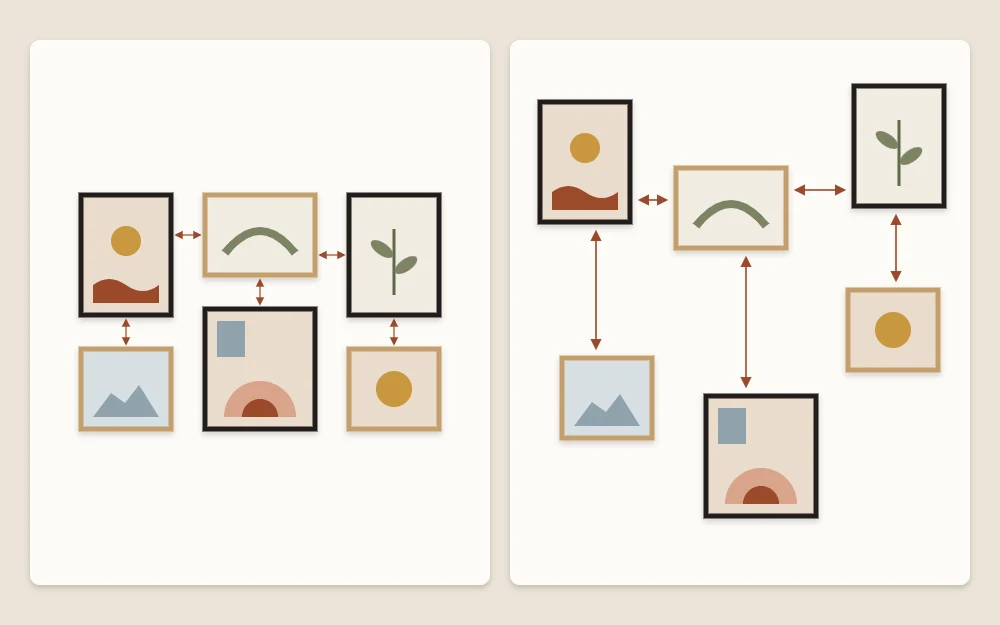
In a grid, the gap is identical in both directions, and any slip is easy to see; the guide to a grid gallery wall shows how to work out the overall size from frame size plus gaps. In a loose cluster the edges do not line up, so aim for gaps that are close to equal wherever two frames face each other.
Make a paper spacer strip
A spacer is quicker and more reliable than measuring every gap with a tape measure.
- Decide your gap by trying two or three widths with the frames laid on the floor.
- Cut a strip of stiff card to that width, or fold a sheet of paper several times until it is that wide.
- Hold the strip between two neighbors each time you position a frame, vertically and horizontally.
- Keep the strip until the last frame is up, so the final gap matches the first.
The spacer works just as well with paper cutouts as with real frames. Setting the gaps at the cutout stage, as described in the guide to gallery wall paper templates, means every gap is settled before you make a hole. When you get to fixing, choose mounting hardware for your wall type and the weight of each frame, and follow the manufacturer instructions.
Tip
Measure the gap between the outer edges of the frames, not between the pictures inside them. Two frames with wide mats can look far apart even when their edges are close.
The space between the furniture and the lowest frames
This gap ties the display to what stands beneath it. Roughly 6 to 10 in (15 to 25 cm) above a sofa back or console top is a common starting point, depending on how tall the furniture is, whether heads rest against the wall and how tall any lamps or objects on the surface are.
Go lower above a console nobody leans on, and a little higher behind seating. Whatever you hang above the sofa needs to be securely fixed. If the bare band between furniture and frames looks taller than the frames themselves, the group will seem to float, so bring it down.
Ceilings, switches and door frames
The margin around the whole group should be clearly wider than the gaps inside it. That contrast is what separates the display from the room.
- Ceiling and corners. Leave a generous band of bare wall. A group that stops short looks placed; one that touches the edges looks squeezed.
- Switches and thermostats. Either keep the whole group clear of them, or treat the switch plate as a small frame and give it the same gap as everything else.
- Door frames and windows. Keep the nearest frame farther from the trim than your internal gap, and out of the path of an opening door.
Spacing on small walls
Narrow walls reverse the usual instinct. Spreading three small frames to fill the space makes them look lost, while pulling them close, toward the tighter end of the table above, turns them into one confident shape with bare wall around it. The collection of small gallery wall ideas has arrangements designed for narrow strips and short walls.
Signs your gap needs adjusting
- Too wide: when you squint, you see wall with pictures on it instead of one shape.
- Too tight: frames seem to merge, or a thick frame overshadows its neighbor.
- Inconsistent: your eye keeps returning to one spot where the space opens up or pinches.
Frequently asked questions
Should the gaps be the same vertically and horizontally?
Matching them is the simplest approach and suits grids and tidy rows. In a loose cluster the gaps only need to look alike, because edges do not line up. A slightly different vertical gap can work in a stacked column, as long as it repeats all the way through the group.
Do larger frames need more space between them?
Often a little more, yes. Large pieces are viewed from farther away and can look cramped with a gap that suits small frames. As a starting point, try the wider end of your range, then step back and adjust, since the answer depends on the wall, the frame thickness and how busy the art is.
How do I space frames of different sizes evenly?
Measure between the outer edges of neighboring frames instead of between centers, and use a spacer strip cut to your chosen gap. Wherever two frames face each other, the strip should fit between them. The outer outline will be irregular, but the equal gaps hold the group together.