Large Gallery Wall Ideas: Filling a Big Wall Without Chaos
Seven ways to give a long or tall wall structure: larger lead pieces, a clear outline, related groups, one gap, fewer frame finishes and a display that grows from the center.
A big empty wall looks like the easy case: all that room, nothing to work around. Then you put up the frames you own and they shrink to postage stamps, or you keep adding until the wall hums like a noticeboard. A large gallery wall fails in one of those two ways, lost or cluttered, and both come from the same cause.
The cause is scale. A big wall needs bigger pieces, bigger groupings and firmer limits than a small one, not simply more frames. The seven ideas below are ways of giving a long or tall wall that structure, and you can combine several of them.
1. Start with a few genuinely large pieces
Twenty small frames on a wide wall read as speckle. Two or three large pieces give the eye somewhere to rest and make everything around them look placed.
As a rough test, stand at the far side of the room. If you cannot tell what a piece shows from there, it is a supporting piece, not a lead. Aim for at least two that pass, set well apart, then build around them. If your favorites are small, a large frame with a very wide mat gives a modest picture the wall area of a big one.
2. Draw the outline first, then fill inside it
Decide the outer shape of the display before you place a single frame. On a big wall, the outline is what makes many pieces read as one thing.
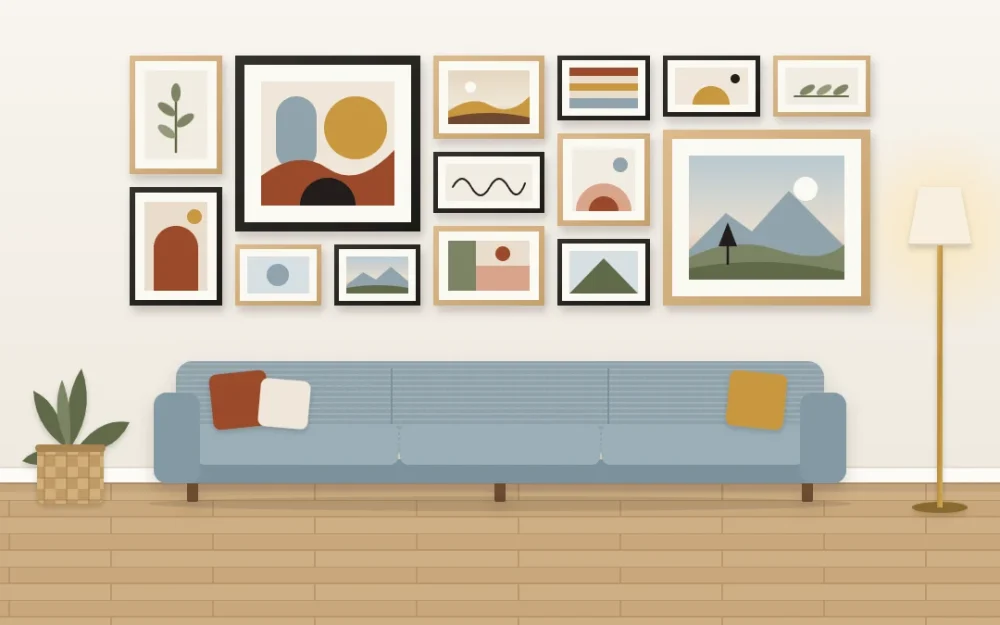
- A wide rectangle. The classic choice above a long sofa or sideboard. The outer frames line up along the top, bottom and sides, even if the inside is loose.
- A band at a constant height. A horizontal strip, two or three frames tall, running the length of the wall. It suits long rooms and walls with a low ceiling.
- A tall block. For a high, narrow wall, a column-shaped outline that rises with the architecture.
Mark the outline on the floor at full size and arrange inside it. Anything that will not fit inside the line waits for another wall.
Tip
If you mark the outline on the wall with painter’s tape, remember that paint finishes and surfaces vary. Test the tape in a hidden spot first and follow the manufacturer instructions for use and removal.
3. Break a very long wall into related groups
Past a certain length, one continuous display is tiring to look at. Two or three groups with a clear pause of bare wall between them are easier on the eye and easier to plan.
For the groups to read as a family and not as strangers, they need shared habits: the same frame finishes, the same gap inside each group, and a common center line so they sit at the same height. Make them different sizes, a wide group and a narrower one, so the wall has rhythm. Then check that no one group outweighs the others, using the ideas in the guide to distributing visual weight.
4. Hold one gap across the whole display
The more frames there are, the more the spaces between them matter. Thirty frames mean dozens of gaps, and if those vary the wall looks restless however good the art is.
Choose one gap and keep it everywhere. Large pieces on a large wall can usually take a slightly wider gap than a small cluster would, but what suits yours depends on the frame dimensions, the wall and your taste. Cut a strip of card to the chosen width and use it as a spacer so you are not measuring every time.
5. Limit the frame finishes
Variety that looks charming across seven frames turns noisy across twenty. On a big display, restraint in the frames lets the pictures carry the interest.
- Pick two finishes, three at most, such as black with oak, or white with brass.
- Spread each finish across the full width instead of gathering it in one area.
- Keep mat colors consistent, all white or all off-white.
- Let frame widths vary a little if you like; that reads as texture, not clutter.
6. Tie the display to the furniture below
A large display that ignores the furniture floats. One that relates to it looks built in. Center the outline on the sofa or sideboard, not on the wall, if the two differ, and keep the display a little narrower than the piece beneath so the furniture visibly carries it.
Keep the lowest row close enough to the furniture that the two read as one unit; a wide strip of bare wall between them cuts the composition in two. Frames above the sofa need to be securely fixed, since people sit and lean directly below them. For more on arranging around seating, lamps and a television, see the ideas for a living room gallery wall.
Leave margins too. Stop well short of the corners, the ceiling and any door frame. Bare wall around the edge is what tells the eye where the display ends.
7. Build from the center in stages
You do not need to fill a big wall in a weekend, and it often turns out better if you do not. Plan the full outline, then hang the core: the large pieces and the frames between them. Live with it. Add outward toward the planned edges as you find pieces worth including.
Because the outline was decided at the start, each addition has a place to go, and the wall looks complete at every stage instead of half done. The same grow-from-the-middle logic is explained step by step in the guide to building a loose cluster that still looks planned.
Reaching the high pieces safely
A tall wall puts the top row well above comfortable reach, and big frames are awkward to lift and hold in position.
Before you hang anything
Use stable, safe access for anything above arm’s reach, and have a helper with you: one person to hold and steady, one to position. If the work means going up a ladder with a large or heavy piece, or reaching over furniture, consider a professional installer. Choose mounting hardware to suit your wall type and the weight of each piece, and follow the hardware manufacturer instructions.
Planning helps here as well. Put the largest and heaviest pieces in the lower and middle rows, where they are easier to handle and look more grounded, and keep the highest row for smaller, lighter frames. Settle the whole arrangement on the floor and with paper templates first, so that each piece only has to go up once.
Frequently asked questions
How many frames do I need for a large gallery wall?
There is no set number. A wide wall can look complete with ten to fifteen frames if a few of them are large, and cluttered with thirty if they are all small. Decide the outline you want to fill, then choose pieces to suit it, starting with the biggest.
Should a large gallery wall cover the entire wall?
Usually not. A display that stops short of the corners, the ceiling and the door frames reads as a composition, while one that runs edge to edge starts to look like wallpaper. Leave a clear margin of bare wall on every side, wider than the gaps between the frames.
Can I build a large gallery wall over time?
Yes, and it is a sensible approach. Plan the full outline at the start, hang the largest pieces and the frames between them, then add toward the planned edges as you collect more. Keeping the same gap and frame finishes with each addition keeps the display coherent while it grows.