Symmetrical vs Asymmetrical Gallery Wall: Which Suits Your Room?
A side-by-side comparison of mirrored and off-center arrangements, four questions that help you decide between them, and a middle path for anyone who wants a little of both.
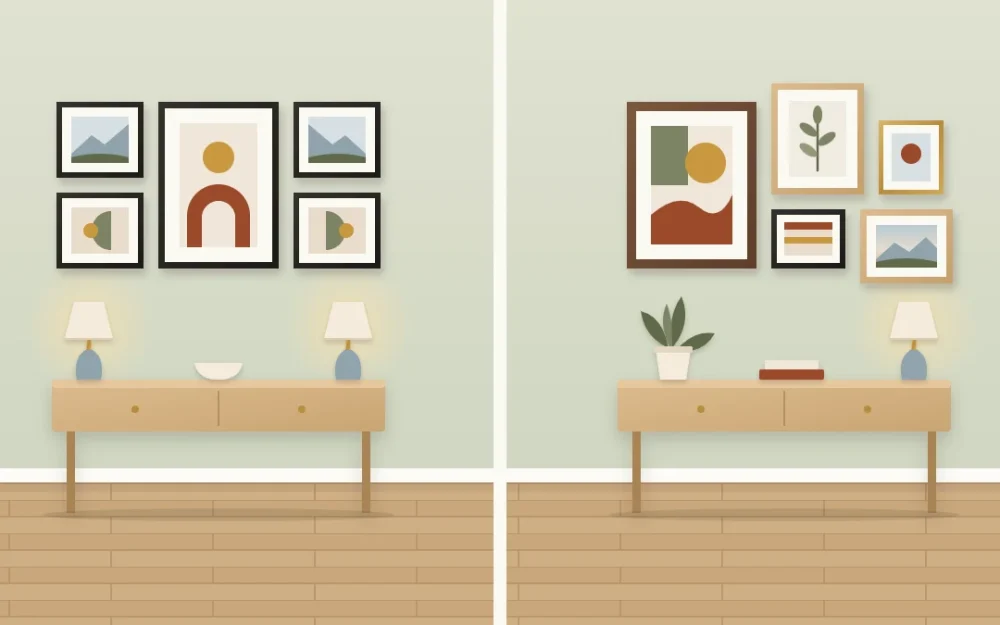
Before you choose a single frame position, one decision shapes everything else: will the two halves of the display mirror each other, or not? A symmetrical gallery wall and an asymmetrical one can use the very same pictures and leave a room feeling completely different.
Neither is the better choice in general. One suits certain rooms, furniture and collections; the other suits different ones. The comparison and the four questions below are meant to get you to a decision you will not second-guess once the frames are up.
The two approaches side by side
| Symmetrical | Asymmetrical | |
|---|---|---|
| How it is built | Left and right halves mirror each other around a center line | Halves differ but carry similar visual weight |
| Mood | Calm, formal, settled | Relaxed, personal, lively |
| Furniture below | Centered on the wall, often with a matching pair of lamps or chairs | Off-center, or styled with unlike objects at each end |
| Frames | Matching, or in matching pairs | Mixed sizes, finishes and orientations |
| Odd pieces | Hard to place; each one needs a partner | Easy to absorb |
| Adding later | In pairs, or the mirror breaks | One at a time, at the edges |
| Tolerance for error | Low; a small slip is obvious | Higher; small slips disappear |
What a mirrored arrangement gives you
Picture a vertical line down the middle of the display. In a symmetrical arrangement, whatever sits to the left of that line has a twin of the same size at the same height on the right. Often a single larger piece sits on the line itself, with pairs stepping outward from it.
The effect is order. Symmetry is easy for the eye to read, so the wall feels quiet even with many frames on it. That makes it a natural fit for traditional rooms, where pairs are already everywhere, and for minimal rooms, where a tidy block of frames keeps the calm.
The cost is rigidity. You need pieces in matching sizes, the furniture has to sit on the same center line, and a frame that is slightly off shows at once. The strictest version is the grid; if that is where you are heading, the guide to planning neat rows and columns covers the measuring.
What an off-center arrangement gives you
Asymmetrical does not mean unbalanced. The two sides are different, but neither looks heavier: one large piece on the left might be answered by three small ones on the right. The display has a center of gravity, just not a mirror line.
It reads as collected and informal, and it accepts almost anything: an upright portrait beside a wide landscape, a round mirror, a frame you bought on a trip. It suits rooms where the furniture is already informal, and it suits people whose collection is still growing.
The cost is that there is no formula to check against. You judge the result by eye, which takes a few trial versions. The step-by-step method for building a loose cluster that still looks planned makes that process far less hit and miss.
Four questions that settle it
What sits below the wall?
Look at the furniture first. A sofa or console centered on the wall, with a lamp at each end, already has a mirror line, and a symmetrical display will lock onto it. A console with one lamp and a plant, a bed pushed toward a corner, or a desk beside a window has no such line, and mirrored frames above it will look as though they belong to another room.
How alike are your pieces?
Lay everything on the floor and try to make pairs by size. If nearly every frame has a partner, symmetry is available to you. If you have seven frames in six sizes, forcing a mirror means buying more frames or leaving favorites out. Let the collection you own vote.
How much will the wall change?
A mirrored arrangement is a finished statement. Adding one picture later means adding two, or rearranging the lot. If you expect to bring home new pieces, swap things often, or add a child’s drawing every year, an asymmetrical layout will accept each newcomer without complaint.
How is the rest of the room arranged?
Stand in the doorway. Paired armchairs, a centered rug and matching side tables call for a wall that follows the same logic. A room with a corner sofa, a single reading chair and shelves on one side is already asymmetrical, and a loose display will feel at home in it. You can go against the room on purpose, using a strict block of frames to steady a busy space, but make it a choice and not an accident.
A middle path: a mirrored core with looser edges
If you are torn, you do not have to pick a side. Build a small symmetrical core, then let the outer pieces relax.
- Start with one larger piece on the center line of the furniture.
- Flank it with a matching pair, one each side, at the same height.
- Beyond that pair, add pieces that differ from left to right: two small frames stacked on one side, a single medium one on the other.
- Keep the gap between frames the same throughout, so the strict part and the loose part read as one display.
The core gives the calm of a mirror where the eye lands first. The edges give you somewhere to put odd sizes and room to add more. Check that the two loose ends still weigh about the same, using the ideas in the guide to distributing visual weight.
Test both before you commit
Arrange your frames on the floor in a mirrored version, take a picture from above, then rearrange them off-center and take another. Look at both pictures the next morning. One of them will usually look like your room, and the decision makes itself.
Before you hang anything
Whichever arrangement you choose, pick mounting hardware to suit your wall type and the weight of each piece, and follow the hardware manufacturer instructions. Pieces that go above the sofa or another seat need to be securely fixed.
Frequently asked questions
Is a symmetrical gallery wall harder to hang than an asymmetrical one?
It is harder to get exactly right, because any frame that sits a little high or wide breaks the mirror and the eye catches it. An asymmetrical arrangement hides small slips better, but takes longer to design, since you have to judge the result by eye over several trial versions.
Can I make a symmetrical arrangement with frames of different sizes?
Yes, as long as the sizes come in pairs. A mirrored display can include large, medium and small frames, provided each one on the left has a twin of the same size on the right. A single unpaired piece can sit on the center line; more than one usually breaks the effect.
Does an asymmetrical gallery wall work above a centered sofa?
It can. Keep the overall group centered on the sofa even though the pieces inside it are not mirrored, and make sure neither end looks heavier than the other. Different objects on the side tables, such as a lamp on one and a plant on the other, help the looser arrangement feel deliberate.