Gallery Wall Balance: How to Distribute Visual Weight
Learn what makes a piece look heavy or light, spot the four imbalances that make an arrangement lean, and fix them with a few swaps and three quick visual checks.
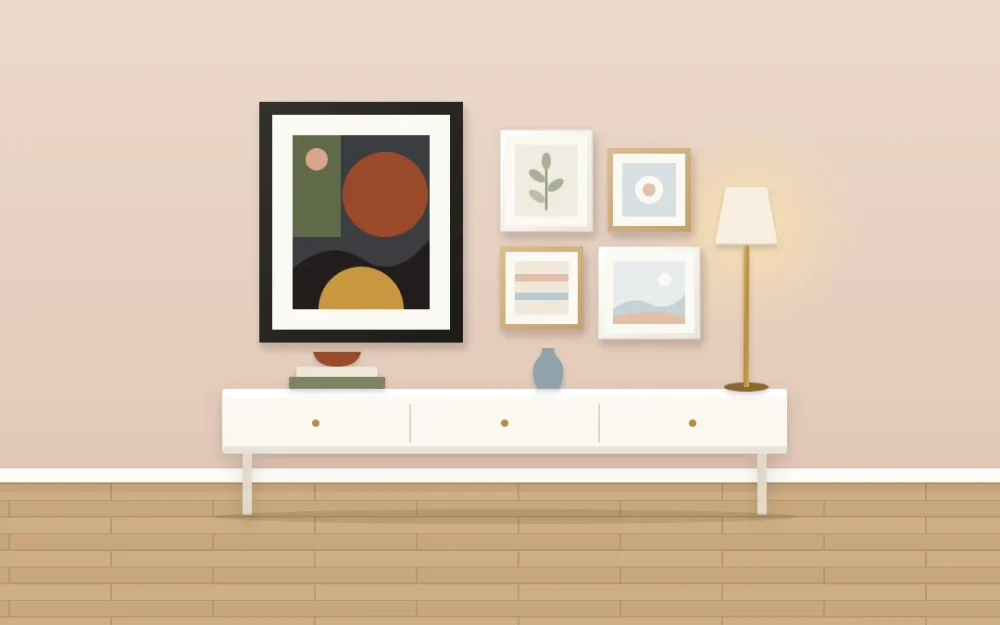
Something about the arrangement is off. The gaps are even, the frames are straight, and still one side seems to sag while the other floats. That feeling has a name, and it is almost never about measurements. It is about gallery wall balance: how the visual weight of the pieces is spread across the group.
Visual weight has nothing to do with what a frame weighs in your hands. It is how strongly a piece pulls the eye. Once you can see which pieces pull hard and which barely pull at all, a lopsided wall becomes a puzzle with a short list of fixes.
What makes a piece look heavy or light
Several qualities add up, and one piece can be heavy in one way and light in another.
| Quality | Reads heavier | Reads lighter |
|---|---|---|
| Size | Large | Small |
| Tone | Dark | Pale |
| Color | Saturated, strong | Muted, soft |
| Frame | Thick, dark or ornate | Thin, pale or plain |
| Image | Busy, dense, high contrast | Simple, with open space |
| Mat | None, or narrow | Wide and white |
A small picture can outweigh a large one. A postcard-sized print in deep red with a chunky black frame will pull harder than a big pale pencil sketch in thin oak. Sort your pieces by pull, not by dimensions.
Find the problem: four common imbalances
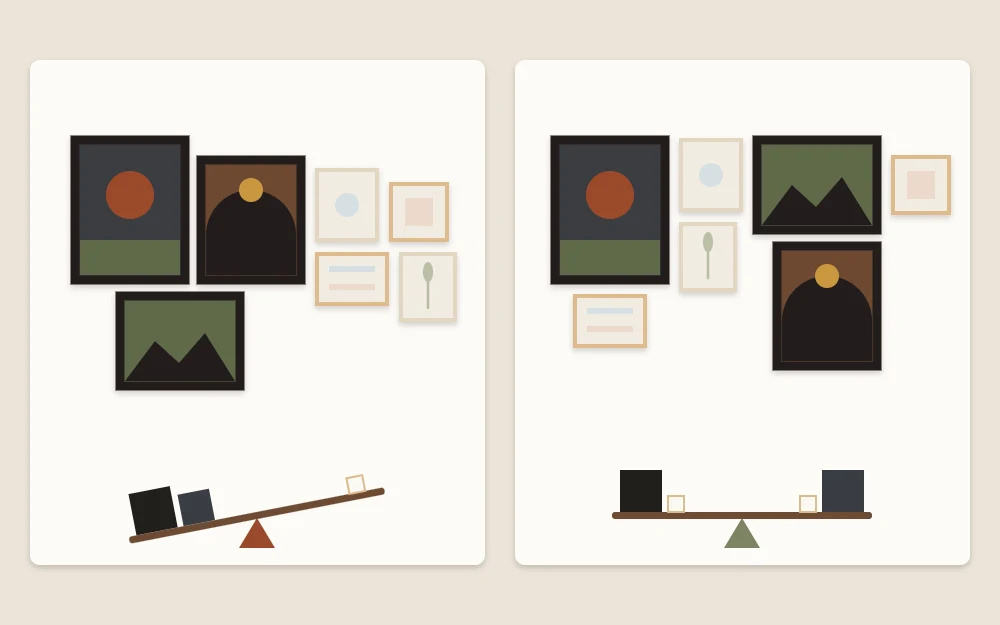
Heavy pieces stacked on one side
What you see: the group seems to lean, and your eye keeps sliding to the same end.
The fix: separate the heavy pieces. Move one to the opposite side and, if you have three, place them as a wide triangle with lighter pieces in between.
One large piece with nothing to answer it
What you see: a big frame on one side and a few scattered small ones that seem to belong to a different wall.
The fix: answer it with a group. Pull three or four small pieces close together on the other side so they read as a single block of about the same area. Tight gaps inside that block matter; spread out, the small pieces lose their combined pull. If the large piece is meant to be the star, the guide to choosing and placing an anchor piece shows where it sits best.
Top-heavy
What you see: the display seems to press down on the furniture or hover uneasily above it.
The fix: bring the heaviest pieces lower or toward the middle and let the light ones rise. Weight near the bottom or center looks grounded, the way a pyramid looks more stable than a mushroom.
One color stranded in a corner
What you see: a single strong blue or red, or the only brass frame, that you cannot stop looking at.
The fix: repeat it diagonally. Put a second piece with the same color or finish at the opposite corner, and a third somewhere between if you have one. The eye then travels across the whole group instead of stopping at one spot. If no second piece exists, move the loner toward the center, where a single accent looks intended.
Three quick checks that show what your eye misses
After staring at an arrangement for an hour you stop seeing it. These reset your view.
- The squint test. Step back and half close your eyes until the detail blurs. You are left with dark and light blobs. If the dark blobs gather on one side, so does the weight.
- A grayscale picture. Take a phone picture and switch it to black and white. Color stops distracting you, and tone, which carries most of the weight, becomes obvious.
- The mirror image. Flip that picture left to right, or look at the wall in a hand mirror. A reversed view is unfamiliar, so a lean you had stopped noticing jumps out.
Tip
Run these checks on a floor layout or on paper templates, before the frames go up. Rebalancing is free at that stage.
Count the furniture as part of the composition
The frames do not hang in empty space. A tall lamp, a large plant, a dark vase or a stack of books under the display all carry visual weight, and they sit in the same view.
Use that. If the heavier frames sit to the left, a tall lamp at the right end of the console can even things out without moving a single picture. If the furniture itself is off-center on the wall, shift the weight of the frames toward the emptier side to compensate.
It works in reverse too. When a wall you thought was balanced suddenly feels wrong, check whether something below it has moved. A new lamp or a missing plant can tip an arrangement that has not changed at all.
Balanced does not mean mirrored
You can reach balance by making both halves identical, or by making them different but equal in pull. The first is calmer and stricter; the second is looser and more forgiving. If you are not sure which suits the room, the comparison of mirrored and off-center arrangements will help you choose.
Scale matters as well. On a wide display with many pieces, treat each section as its own small composition and then balance the sections against one another, an approach covered in the ideas for filling a big wall without chaos.
When you move frames to fix it
Rebalancing often means swapping positions, and a swap can put a larger piece where a small one used to be.
Good to know
Do not assume the existing fixing suits the new piece. Choose mounting hardware for your wall type and the weight of the frame going onto it, and follow the hardware manufacturer instructions. For a large mirror or a big glazed frame, get help if you are unsure.
Change one thing at a time and repeat the squint test after each move. Two or three swaps are usually enough, and the wall will tell you when to stop: your eye starts moving around the whole group and no longer settles on one side.
Frequently asked questions
Why does my gallery wall look lopsided when the spacing is even?
Even gaps control how tidy the group looks, not how its weight is spread. If the largest, darkest or most colorful pieces sit together on one side, that side pulls the eye harder and the arrangement seems to lean. Moving one heavy piece across the group usually corrects it.
Where should the heaviest-looking piece go?
Low or near the center is the most stable place for it, because weight in those positions looks grounded. If it sits to one side, give the other side something of similar pull, such as a tight group of smaller frames or a tall lamp on the furniture below.
Can I balance a gallery wall without rehanging anything?
Sometimes. Try changing what stands below the display first: a lamp, plant or dark vase placed under the lighter side adds weight there. Swapping the art between two frames of the same size is another option, since a dark, busy image and a pale, simple one pull very differently.