Gallery Wall Focal Point: Choosing and Placing an Anchor Piece
How to pick the piece that leads your display, where to place it, how the other frames step down around it, and when a wall is better off with no anchor at all.
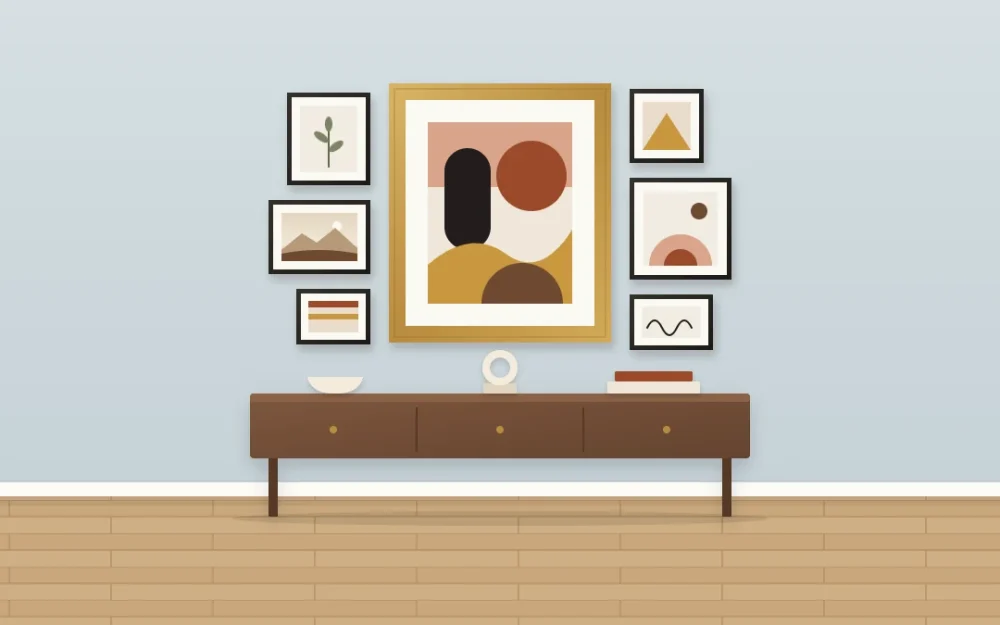
Walk into the room and notice where your eye lands first. On a display that works, it lands on one piece, rests there, then drifts out to the others. On one that does not, it skips from frame to frame and settles nowhere. The difference is a gallery wall focal point.
That lead piece is often called the anchor. You may already own it, a picture you love more than the rest, or you may need to appoint one from a set of near equals. Either way, choosing it and placing it comes before every other decision about the arrangement.
What an anchor does for the eye
A group of pictures is a lot to take in. An anchor gives the viewer an entry point and a hierarchy: this first, then those. It also gives you a starting position when you plan, because every other piece is placed in relation to it.
Without one, a display of mixed pieces reads as a collection of separate things. With one, it reads as a single composition that happens to have many parts.
Four ways to choose the anchor
- The largest piece. Size is the most reliable signal. If one piece is clearly bigger than the rest, the eye will go to it whether you plan for that or not, so make it official.
- The boldest piece. When sizes are similar, pick the strongest color, the darkest tones or the highest contrast. A vivid abstract among soft sketches leads without being large.
- The most meaningful piece. The picture you most want people to notice deserves the position, even if it is modest. It may need help to hold it, which the section on promoting a small favorite covers.
- A mirror. A mirror makes a strong anchor because it differs from everything around it: it is bright, it changes through the day and it is often a different shape.
If two pieces compete, choose one and move the other well away from it, or leave it out. Deciding which pictures belong in the group at all is a separate job, covered in the guide to choosing pieces that belong together.
Where to put it
Near eye level
The anchor belongs where people look without tilting their heads. Roughly 57 in (145 cm) from the floor to the middle of the piece is a common starting point for a standing viewer. The height that suits your wall depends on the furniture below, the ceiling, the dimensions of the piece and whether the room is mostly used sitting down, in which case a lower position is more comfortable.
Centered, or off-center on purpose
A centered anchor suits a mirrored arrangement and furniture that sits in the middle of the wall. An off-center anchor, about a third of the way in from one side, suits a looser display and leaves room to grow on the other side. The method for building a loose cluster starts from exactly that position.
What rarely works is halfway between the two. An anchor that is only slightly off the middle looks like a measuring mistake. Commit to one or the other.
Not at the outer edge
Keep the anchor inside the group, with at least one piece between it and each outer edge where space allows. At the edge it drags the eye out of the composition and makes the opposite side look empty.
Let the other pieces step down in size
Supporting pieces should look like supporting pieces. Put the medium frames next to the anchor and the smallest ones farthest out, so size falls away gradually from the center of attention.
- Avoid placing your second-largest piece directly beside the anchor; the pair will merge into one heavy block.
- Keep the gaps around the anchor the same as everywhere else. Extra space around it isolates it instead of honoring it.
- Let quieter pictures sit closest to it and save a second strong color for the far side.
A strong anchor is also the heaviest thing in the display, so it needs something to answer it. The guide to distributing visual weight explains how to keep it from tipping the group.
Promoting a small favorite
Sometimes the piece that matters most is the smallest: a child’s first drawing, a tiny sketch bought from its maker, a snapshot. You can give it enough presence to lead.
- A much wider mat. A small image in a large frame with a broad mat around it takes up the wall area of a big piece and looks treasured.
- A contrasting frame. If every other frame is thin and black, one wide brass or deep wood frame stands apart at once.
- The only one of its kind. Make it the single round frame, the single color image among monochrome ones, or the single piece without glass.
Tip
Use one of these devices on one piece only. Three frames with extra-wide mats give you three focal points, which is the same as none.
One focal point or two?
For most displays, one. A second anchor begins to make sense when the display is very wide, such as a long run above a large sofa or sideboard, where a single piece cannot hold both ends.
If you use two, treat them as a pair of unequal partners. Make one clearly dominant, set them well apart, roughly a third of the way in from each end, and fill between them with smaller pieces so they do not read as rivals. Two equal anchors side by side split the wall in half.
When a wall needs no anchor at all
A grid of identical frames is the clear exception. Its strength is that no piece outranks another; the whole block is the focal point, and a standout image would break the pattern. The same goes for a straight row of matching frames along a hallway.
The test is simple. If your pieces are equal on purpose, same frame, same size, same kind of image, skip the anchor. If they are unequal, choose one and let it lead.
Before you hang anything
An anchor is often the largest piece you own. Choose mounting hardware for your wall type and the weight of the piece, and follow the hardware manufacturer instructions. For a mirror or a big glazed frame, get help lifting and positioning it if you are unsure.
Frequently asked questions
Does the focal point have to be the biggest piece?
No. Size is the easiest way to make a piece lead, but strong color, a contrasting frame, a much wider mat or a different shape can do the same job. A small favorite can anchor a display if it is the only piece treated that way and the pieces around it stay quieter.
Should the anchor piece go in the exact center of the gallery wall?
Only if the arrangement is meant to be mirrored. In a looser display the anchor usually looks better about a third of the way in from one side. Avoid placing it just slightly off the middle, which tends to look accidental, and keep it away from the outer edge of the group.
Can a mirror be the focal point of a gallery wall?
Yes, and it often works well, because a mirror is brighter than framed art and frequently a different shape. Place it as you would any anchor, with smaller frames stepping down around it, and think about what it will reflect from the main viewing spot in the room.