Small Gallery Wall Ideas for Narrow and Awkward Walls
Five compact arrangements of three to five frames for narrow strips, short walls and tight corners, with tips on frame scale, gaps and margins so a small wall looks composed instead of crowded.
At a glance
- Difficulty
- Easy
- Time
- About 1 to 2 hours, plus hanging
- Best for
- A narrow strip, short wall or tight corner
- Renter note
- Planning needs no holes; hanging does. Check your lease or ask before making changes.
What you need
- Tape measure
- Pencil
- Three to five small frames
- Painter's tape or chalk
- Level
Nothing says a gallery wall needs a dozen frames and a long stretch of plaster. Three pieces that share a center line and an even gap are a gallery wall. So are four small squares in a block. A small gallery wall is often the more satisfying project, because it is finished in an afternoon and every piece gets looked at.
The walls that suit it are the ones usually left bare: the strip between two doors, the short return beside a wardrobe, the patch above a desk. What follows is where to look, five arrangements sized for those spots, and how to scale the frames so the wall feels composed and not stuffed.
Where small walls hide
Walk through your home and look for surfaces narrower than a doorway or shorter than your arm span. They are easy to overlook because no furniture sits against them.
- The strip between two doors, or between a door and a window.
- The side of a chimney breast or the wall beside a wardrobe.
- The space above a desk, a small table or a shelf fitted over a radiator.
- The end wall of a short corridor, seen straight on as you walk toward it.
- The wall just inside the front door.
The last two have their own guides: see the ideas for displays along a narrow hallway and for a compact arrangement by the front door.
Five arrangements that fit a tight space
1. A vertical stack of three
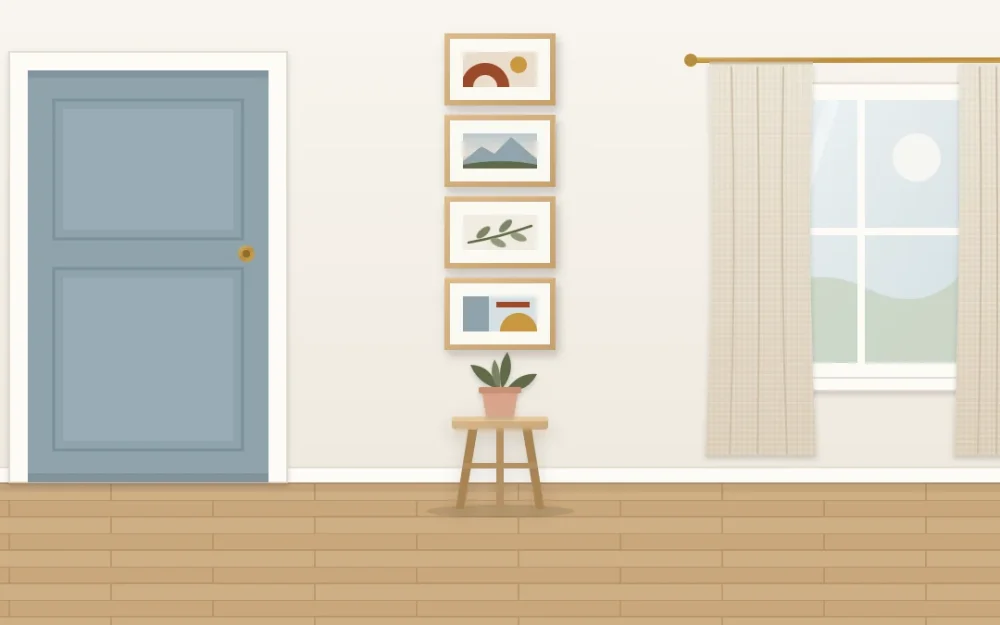
Three frames of the same width, one above another on a shared center line. This is the natural answer to a tall, narrow strip, and it draws the eye upward, which makes a low room feel a little taller. Use the same frame for all three and let the art vary.
2. A tight two-by-two
Four identical square frames in a block. It reads as one larger square, so it gives a small wall a single confident shape. It needs frames that match and gaps that are equal, since any drift shows.
3. One medium piece with two small ones
A medium frame on one side and two small frames stacked beside it, their combined height matching the larger piece. You get the variety of a bigger gallery wall inside a neat rectangle, and it suits walls that are slightly wider than they are tall.
4. A mini row above a small table
Three small frames side by side above a desk, a bedside table or a narrow console. Keep the row a little narrower than the furniture so the two read as a pair.
5. A column beside a door or window
Two to four small frames running up the wall next to a frame or casing. Line the column up with the middle of the strip, not with the edge of the door, so it looks placed and not squeezed in.

Scale the frames to the wall
On a small wall, the frames and the spaces between them need to shrink together. Four habits help.
- Smaller frames with generous mats. A small picture with a wide mat looks deliberate and brings white space into a tight spot.
- Thin frame profiles. Chunky moldings eat the little width you have and make the group look heavy.
- Tighter gaps. Close spacing holds a few pieces together as one shape.
- A restrained palette. One frame finish and two or three colors in the art. A small wall has no room to resolve a busy mix.
For the gaps, about 1.5 to 2 in (4 to 5 cm) between small frames is a common starting point. The number that suits your wall depends on the frame dimensions, the width of the wall and your own eye, so adjust it once the pieces are laid out. The full reasoning is in the guide to how far apart to hang frames.
Leave a clear margin
The quickest way to make a small wall feel cramped is to fill it from edge to edge. The bare wall around the group is part of the composition: it works like a mat for the whole arrangement.
As a rough guide, let the margin at each side be clearly wider than the gap between the frames, and keep the group away from door casings, light switches and the ceiling line. If the frames only fit with a sliver of wall on either side, use fewer of them or go down a frame size.
Tip
Check which way nearby doors open before you settle on a spot. A wall that is hidden behind an open door most of the day, or where the handle swings close to the plaster, is better left bare.
Plan it in five steps
- Measure the wall. Note the width and height of the free area, leaving out switches, vents and casings.
- Mark your display area. Subtract a margin on every side. What remains is the outline your frames have to fit inside.
- Choose the arrangement. Tall and narrow suggests a stack or column; roughly square suggests a two-by-two or the one-plus-two group; wide and low suggests a mini row.
- Lay it out on the floor. Tape or chalk the outline on the floor, place the frames inside it and adjust the gaps until they are even.
- Transfer and hang. Start with the middle piece of a stack or row, or the largest piece of a group, and work outward, checking each frame with a level.
Before you hang anything
Choose mounting hardware for your wall type and the weight of each frame, and follow the hardware manufacturer’s instructions. If you use tape for an outline, remember that paint finishes and surfaces vary: test it in a hidden spot first and follow the tape manufacturer’s instructions for use and removal.
What to put in small frames
Small walls are seen from close up, often while you pause at a door or sit at a desk, so detail pays off. Choose your own photos cropped to a single subject, pressed leaves or flowers, small sketches, a child’s drawing or a print bought from its maker.
A simple shared idea ties a tiny group together: three leaves from the same garden, four pictures from one trip, a short run of ink drawings. With so few pieces, one clear theme does more than variety.
Frequently asked questions
How many pictures make a small gallery wall?
Three is enough. Once three or more pieces share a center line or an outline and have even gaps between them, they read as one composition. Most narrow or short walls look best with three to five pieces; more than that usually means the frames are too small or the margins have disappeared.
What size frames work on a narrow wall?
Choose frames that leave clear bare wall on both sides, with the side margins visibly wider than the gaps between the pieces. Small frames with thin profiles and wide mats tend to suit narrow strips. Cut paper shapes the size of your frames and hold them against the wall to judge before buying.
Should a small gallery wall use matching frames?
Matching frames are the easier choice, because a few pieces have little room to resolve a mix of finishes and widths. One finish and one profile let the art provide the variety. If you want to mix, keep it to two finishes and make sure the frame widths are similar.