Bedroom Gallery Wall Ideas for a Calm, Personal Room
Bedroom gallery wall ideas that keep a restful room restful: a quiet row above the headboard, columns over the nightstands, a dresser cluster, a low ledge and a personal group on the wall you see from bed.
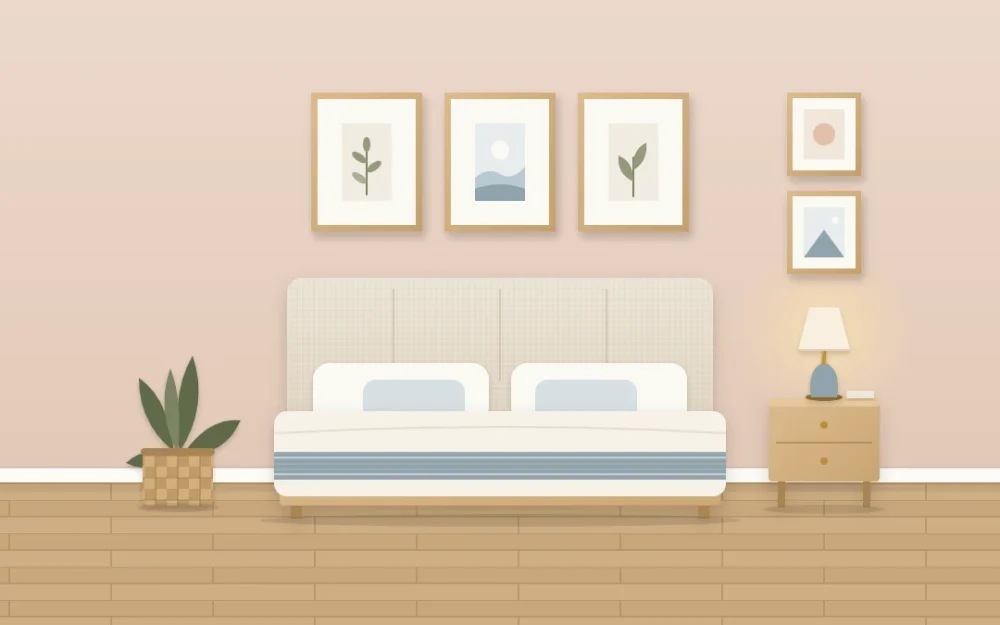
A bedroom asks something different of its walls than the rest of the home. It is the last room you see at night and the first in the morning, so a bedroom gallery wall works best when it lowers the volume: fewer pieces, softer contrast, and plenty of plain wall left around them.
That does not mean bare or impersonal. This is the most private room you have, which makes it the natural home for the pictures that matter to you and nobody else. The aim is a display that feels like yours and still lets the room rest.
What makes a wall feel calm
Three choices do most of the work, and they apply to every idea further down.
- Fewer pieces. Three to six is plenty for most bedroom walls. A small group with room around it reads as deliberate, where a dozen frames read as activity.
- Softer contrast. Pale wood, white or soft gray frames on a light wall are gentler than sharp black outlines. If your wall is dark, mid-tone frames keep the step between frame and wall small.
- More mat and more wall. A wide mat gives each picture a quiet border, and generous margins between the group and the corners let the eye settle.
A tonal palette helps too. If you like the idea of creams, sand and warm gray, the guide to a soft neutral gallery wall shows how to keep that kind of display from going flat.
The wall behind the bed
This is the wall everyone thinks of first, and the one that needs the most thought. A tidy trio or a single row above the headboard suits it well: three matching frames on one level line, spanning less than the width of the bed, echo the horizontal shape of the headboard and stay calm.
As a starting point, try the lowest edge of the frames about 6 to 8 in (15 to 20 cm) above the headboard, then adjust. The gap that looks right depends on the height of the headboard, the size of the frames, the ceiling and how far you lean back when you sit up to read.
Before you hang anything
Pieces above the bed need to be securely fixed, and lightweight frames are the sensible choice there. Choose mounting hardware for your wall type and the weight of each frame, and follow the hardware manufacturer’s instructions. If you are not comfortable with anything over your pillow, put the display on another wall; the options below are just as good.
Above the nightstands
A column of two or three small frames above each nightstand frames the bed without putting anything over it. Keep the columns narrower than the nightstand and start them a little above the lamp, so shade and frames do not crowd each other.
The two sides do not need to be identical. Matching frames with different pictures give you symmetry without stiffness, and if one side has a window or a door in the way, a column on the free side alone still looks intended.
Above the dresser
A dresser wall is the bedroom’s most relaxed spot for a cluster. You see it standing, the furniture gives the group a base, and objects on top can join in: let a jewelry dish, a plant or a leaning frame overlap the lowest picture slightly.
Keep the cluster compact, around two-thirds of the dresser width as a starting point, and leave space if a mirror already lives there. A mirror can also become the largest piece of the group, with three or four frames arranged down one side of it.
A low ledge for leaning frames
A single picture ledge, set on a side wall or above a low chest, gives you a display you can change on a whim. Lean two or three frames of different heights, overlap them a little, and swap one whenever you like. Because nothing is fixed in a set pattern, a ledge never looks crooked.
A ledge also means fewer holes than a full cluster, which appeals if you rent. There are more approaches along those lines in the ideas for a gallery wall with fewer fixings.
The wall you see from bed
The wall behind your head is the one you look at least. The wall opposite the bed, or the one beside it, is what you see when you wake. That makes it the better home for a personal photo group: the trip you still talk about, the people you miss, a drawing a child made for you.
Keep this group small and hang it where your eyes fall naturally from the pillow, which is often a little lower than you would choose standing up. If the only free space is a narrow strip beside a wardrobe or a door, a stack of three can be enough; see the arrangements for narrow and awkward walls.
Subjects and colors that suit rest
What is inside the frames matters as much as where they hang. Pictures with open space, low horizons and soft edges tend to feel quieter than crowded, high-contrast ones.
- Landscapes, water, sky and botanical studies
- Pressed leaves or flowers you gathered yourself
- Your own photographs in one treatment, all soft color or all black and white
- Simple line drawings and tonal abstracts bought from the maker
Pick colors already in the room, such as the bedding, the curtains or a rug, and repeat them two or three times across the group. Save the busiest, brightest pieces for a room where you want energy.
If the room still feels busy
Stand in the doorway, then lie down, and work through these fixes one at a time.
- Too many things to look at: take away the two smallest pieces and close the gaps.
- Frames stand out more than the pictures: swap dark frames for a finish closer to the wall color.
- A bright patch on the glass at night: bedside lamps reflect in glazing. Move the frame up or sideways, turn the shade, or choose non-glare glazing for that piece.
- Pictures on every wall: keep one display wall and one supporting spot, and leave the others plain.
Frequently asked questions
Is it okay to hang pictures above the bed?
Many people do, with care. Choose lightweight frames, make sure each one is securely fixed with hardware that suits your wall type and the frame's weight, and follow the hardware maker's instructions. If the idea makes you uneasy, a dresser wall or the wall facing the bed gives you a display with nothing overhead.
How many pictures should a bedroom gallery wall have?
Fewer than you would use in a living room. Three to six pieces suit most bedroom walls, because open wall around the group is part of what keeps the room quiet. Begin with three, live with them for a week or two, and add another only if the wall still looks unfinished.
What kind of art suits a bedroom?
Pictures with open space and gentle contrast tend to feel restful: landscapes, water, botanicals, simple line drawings and your own photographs in one consistent treatment. Repeat colors already present in the bedding or curtains, and keep loud, crowded pieces for rooms where you want more energy.


