Mixed Media Gallery Wall: Adding Mirrors, Objects and Textiles
Seven things that sit well among framed pictures, from a round mirror to a small textile hanging, and the habits that keep a wall of frames and objects looking composed instead of cluttered.
A wall of framed pictures is a wall of rectangles under glass. Even with good art inside, the overall shape can feel flat: the same outline, the same depth and the same shine repeated a dozen times. A mixed media gallery wall breaks that pattern by letting a few things that are not pictures join the group.
The word that matters is “few”. One mirror and a basket among eight frames looks composed. Eight objects and two frames looks like storage. Below are seven things that sit well among frames, followed by the habits that keep the arrangement reading as a single display.
Seven things that can join the frames
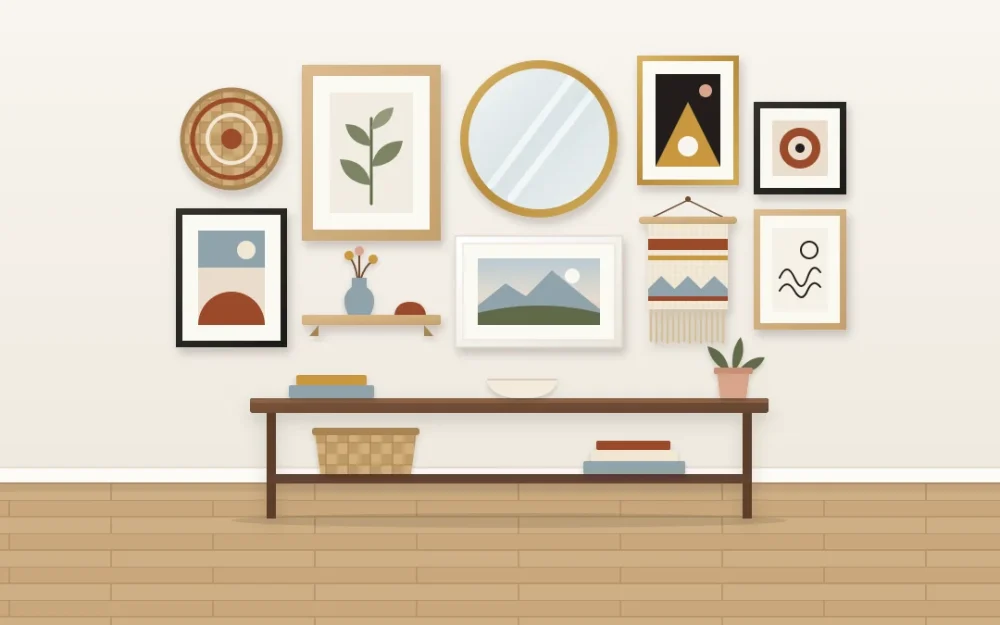
- A mirror. It brings light and a change of surface, and a round or arched one adds a curve the frames lack. Treat it as one of the larger pieces and give it a prominent place. Look at what it will reflect from where you usually sit or stand; a window or a lamp is better than a ceiling corner.
- A flat woven basket or a plate. Both give you a circle with texture or pattern. A shallow basket adds a matte, natural surface that contrasts well with glass. One is usually enough within a group of frames; three in a tight cluster can work as a single unit.
- A small textile hanging. A weaving, a piece of macrame or a stitched panel on a rod softens the hard edges around it. A fringe or an uneven lower edge is useful, because it interrupts the straight lines.
- A shallow shelf with one object. A short ledge holding a small vase, a stone or a ceramic piece adds real depth. Keep it to one or two objects so it stays part of the wall instead of becoming a surface that collects things.
- A plug-in wall lamp. A small sconce with a cord and plug adds a different shape and makes the display usable in the evening. Let the cord drop straight down as a deliberate line or run it inside a cord cover. A fitting connected to the building’s wiring is a job for a licensed electrician.
- A sculptural piece. A carved wooden form, a small relief, a ceramic wall piece or a weathered branch found on a walk. Choose something with a clear silhouette that reads from across the room.
- A clock. A plain clock with a quiet face can take the place of a round frame. Pick one without a loud tick or a busy dial, and place it away from the middle so it does not become the thing everyone looks at.
Keep frames in the majority
What makes this a gallery wall and not a display of objects is that pictures still do most of the work. As a rough guide, let two out of every three pieces be frames. On a wall of nine, that is six frames and three objects.
Choose the pictures with the same care as before. The objects add contrast, but the art still carries the theme. If you have not yet settled on what holds your pictures together, the guide to choosing art that works as a group is the place to start.
Spread the objects out
Objects attract the eye more than frames do, because they are different. Put two side by side and that part of the wall becomes heavy while the rest looks plain. Place them so each object has frames between it and the next one, ideally at different heights.
A simple test: draw a loose triangle between your three objects. If the triangle covers most of the arrangement, they are well spread. If it is a thin sliver on one side, move one across. Objects also differ a lot in how heavy they look, with a dark mirror frame reading very differently from a pale basket. The article on distributing visual weight across a gallery wall explains how to even that out.
Let one or two round shapes break the grid
Curves are the main reason to add objects at all. A single circle among rectangles relaxes the whole arrangement. Two circles of different sizes, placed diagonally from each other, give the eye a path to follow.
More than two or three round shapes and the effect reverses: the circles become the pattern and the frames start to look like the interruption. Give each curved piece slightly more room around it than a frame would get, since a circle beside a rectangle leaves awkward corner gaps if they sit too close.
Keep it shallow where people walk
Frames sit nearly flat. Shelves, lamps and sculptural pieces do not. In a living room corner that hardly matters, but in a hallway, beside a doorway or behind a chair that gets pulled out, anything that projects is something to catch a shoulder or a bag on.
In those spots, stay with flat additions such as a mirror, a basket, a plate or a textile. Save the shelf and the lamp for walls with furniture in front of them, where a console or sideboard keeps people at a distance.
Tie the materials to the frames
An object looks as if it belongs when it repeats something already on the wall. A woven basket picks up the tone of oak frames. A brass mirror frame answers one brass picture frame. A textile in cream and rust echoes the same colors in a print.
Aim for each material to appear at least twice. An object in a material and color seen nowhere else on the wall or in the furniture below tends to look as though it was hung there for want of another place.
Fixing objects to the wall
Every object type hangs differently. A mirror, a plate, a basket, a textile rod and a shelf each need their own kind of fitting, and what suits one will not suit another.
Before you hang anything
Choose mounting hardware made for the object, suited to your wall type and to the object’s weight, and follow the hardware manufacturer’s instructions. Mirrors and shelves need particular care. If a piece is heavy or large, or you are unsure, get help.
If you would like to keep fixings to a minimum, some of these additions can simply lean or stand: a mirror on a console, a plate on a stand, an object on a ledge you already have. The guide to gallery walls with fewer holes sets out those options and their limits. Check your lease or ask before making changes in a rented home.
Frequently asked questions
How many objects can I add to a gallery wall?
A workable guide is one object for every two frames, so a wall of nine pieces might include three objects. Beyond that the pictures stop leading and the wall starts to look like a collection of things. Begin with one mirror or basket, live with it, and add a second only if the wall still feels flat.
Where should a mirror go in a gallery wall?
Treat it as one of the larger pieces and place it near the middle or slightly off-center, not at the outer edge. Check what it reflects from your usual viewing spot. Because mirrors can be heavy, choose hardware for the wall type and the weight, follow the maker's instructions and get help if unsure.
Do the objects need to match the frames?
They do not need to match, but each should repeat something already present, such as a wood tone, a metal finish or a color from one of the pictures. When a material appears at least twice across the wall or the furniture below, the object looks placed on purpose.